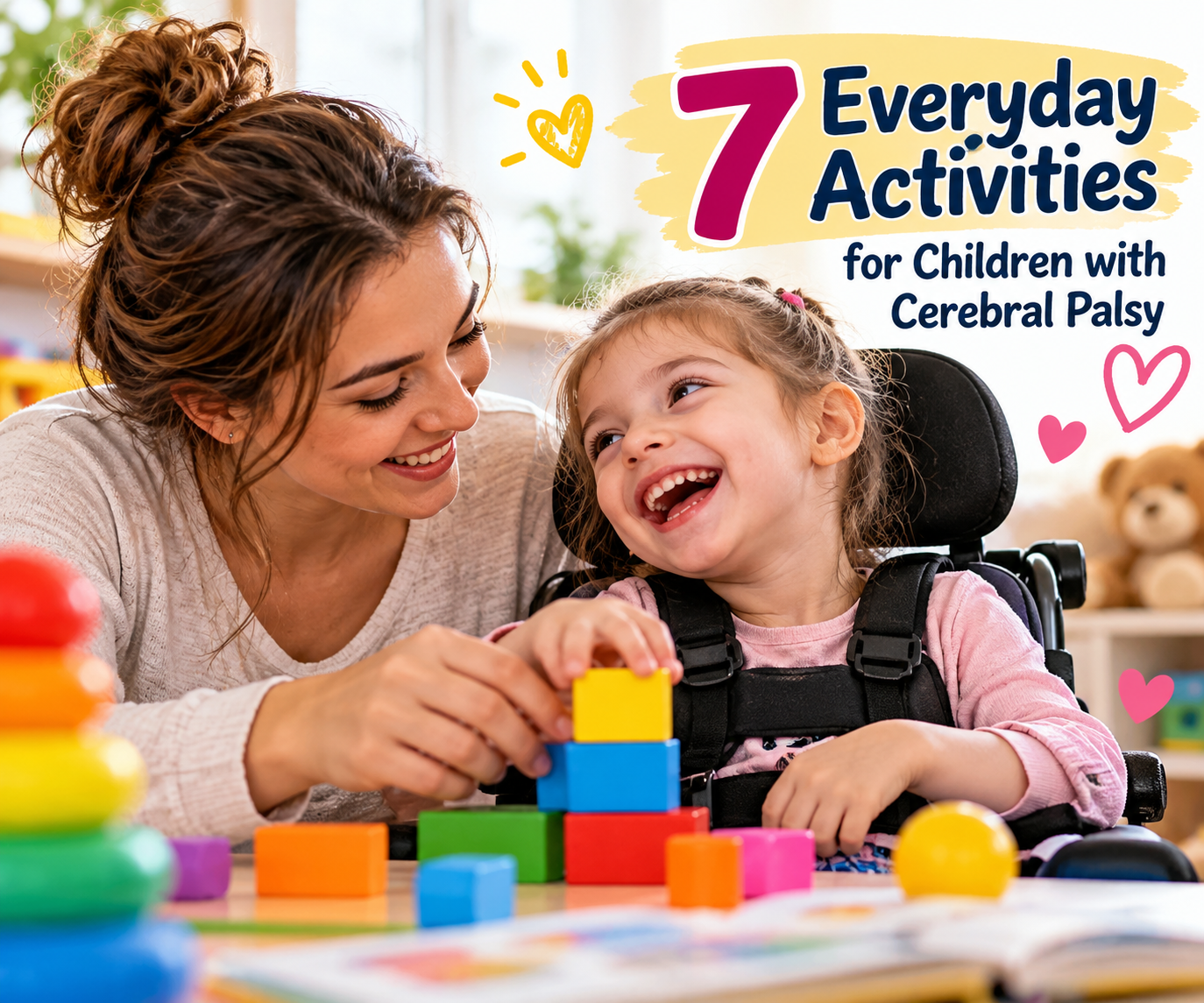
For families raising a child with cerebral palsy, everyday moments can become meaningful opportunities for connection, learning, and participation. From playing with favorite toys to enjoying storytime together, simple activities can be adapted to a child’s abilities, interests, and comfort.
Cerebral palsy affects movement, balance, and posture in different ways. Some children may need additional support with sitting, reaching, communicating, or moving around, while others may participate in many daily activities independently.
There is no single activity that works for every child. The goal is to create enjoyable experiences that encourage participation without unnecessary pressure.
In this guide, we explore seven everyday activities that families can adapt at home, along with practical ways to make them more accessible.
1. Explore Toys Through Play
Play offers opportunities for children to explore their surroundings, express preferences, and interact with family members.
Choose toys that match your child’s interests and abilities. Some children may enjoy large, lightweight blocks, while others may prefer musical toys, textured objects, or toys that respond to a button press.
Ideas to try:
Offer two toys and let your child choose.
Place favorite toys within comfortable reach.
Use toys with easy-to-activate buttons when appropriate.
Follow your child’s interest instead of insisting on one particular activity.
Adapt the activity to your child’s positioning and abilities. An occupational therapist can help identify suitable toys and adaptations.
2. Make Storytime Interactive
Reading together can provide opportunities for language exposure, attention, communication, and bonding.
You do not need to finish an entire book in one sitting. Choose short stories with clear pictures, familiar characters, and topics your child enjoys.
Try pointing to pictures, naming objects, asking simple questions, or giving your child time to respond. A response may be a word, gesture, eye gaze, sound, or communication device.
For children who find traditional books difficult to handle, an adult can hold the book or use digital stories with accessible controls.
3. Enjoy Music and Rhythm
Music can make shared activities enjoyable and provide opportunities for expression.
Play familiar songs, sing together, clap gently if comfortable, or offer simple musical instruments suited to your child’s abilities.
Some children may enjoy tapping a drum, shaking a lightweight instrument, or activating a switch to play a sound.
Keep the volume comfortable and pay attention to your child’s reactions. The purpose is enjoyment and participation, not forcing a particular movement or response.
4. Include Your Child in Everyday Routines
Daily routines can create opportunities for choice and involvement.
During dressing, mealtimes, or getting ready for bed, offer your child ways to participate that match their abilities. They might choose between two shirts, select a song, indicate a preferred activity, or help with a small step.
Allow extra time when possible, and recognize participation in different forms.
If a routine involves challenges with swallowing, feeding, positioning, or fatigue, ask your child’s healthcare team for individualized guidance. Do not change feeding techniques without appropriate advice.
5. Try Simple Art Activities
Art can offer opportunities for creativity and self-expression without requiring a specific level of fine motor control.
Depending on your child’s needs, you might try:
Large crayons or easy-grip markers.
Painting with an adapted brush.
Sticking large paper shapes onto a page.
Choosing colors or pictures for a collage.
Making art together, with an adult helping as needed.
Use age-appropriate materials and supervise activities involving small objects or other potential choking hazards.
Remember that the finished picture is less important than the experience of creating it together.
6. Encourage Comfortable Movement and Position Changes
Movement needs vary considerably among children with cerebral palsy. Some children walk independently, while others use mobility aids or need assistance with positioning and transfers.
Everyday movement should follow the child’s individualized care and therapy plan.
A physical therapist may recommend activities that support comfortable positioning, mobility, balance, or functional movement. Families can ask which activities are appropriate to practise at home and how to perform them safely.
Never force a limb into a position, stretch through pain, or attempt an unfamiliar transfer without proper instruction.
7. Make Communication Part of Every Activity
Communication is not limited to spoken words.
Children may communicate through facial expressions, gestures, sounds, pictures, eye gaze, sign language, or augmentative and alternative communication (AAC) systems.
During play or meals, pause occasionally and give your child time to express a preference. Offer meaningful choices and respond to their attempts to communicate.
If communication is difficult, a speech-language therapist can help identify approaches and tools suited to your child’s needs.
How to Adapt Activities to Your Child
Before starting a new activity, consider the following:
Comfort: Is your child positioned comfortably and able to participate without unnecessary strain?
Accessibility: Can the toy, book, or activity be adapted to make participation easier?
Interest: Does your child enjoy the activity, or would another option be more engaging?
Energy: Is the activity appropriate for your child’s current energy level? Allow breaks whenever needed.
Individual support: Would advice from a physical therapist, occupational therapist, speech-language therapist, or other healthcare professional help make the activity safer or more useful?
Children with cerebral palsy have different strengths and support needs. Activities should be adapted to the individual rather than based only on age or diagnosis.
Supporting Parents and Caregivers
Caring for a child with additional support needs can involve appointments, daily routines, school coordination, and many other responsibilities.
Parents do not need to turn every moment into a therapy session. Shared laughter, quiet time, ordinary play, and family connection are valuable too.
Consider asking trusted family members for practical help, connecting with other caregivers, and discussing respite or community support options with your care team.
Small, manageable routines can make family life easier without placing unrealistic expectations on parents or children.
Frequently Asked Questions
Can children with cerebral palsy enjoy everyday activities?
Yes. Children with cerebral palsy can participate in play, learning, family routines, and recreational activities in different ways. The appropriate adaptations depend on each child’s abilities, interests, and support needs.
Which activities are best for cerebral palsy?
There is no universally best activity. Play, music, reading, art, communication, and individualized movement activities can all provide opportunities for participation. Choose activities that suit the child and consult relevant professionals when specialized guidance is needed.
Should parents practise physical therapy exercises at home?
Only practise exercises recommended or demonstrated by the child’s qualified therapist. Ask for clear instructions about positioning, frequency, safety, and when to stop.
Can these activities replace professional therapy?
No. Everyday activities can complement a child’s broader care and developmental plan, but they do not replace individualized medical care, therapy, or educational support.
Where can families find reliable information?
The U.S. Centers for Disease Control and Prevention (CDC) provides information about cerebral palsy, treatment, early intervention, and services for eligible children and families.
Final Thoughts
Children with cerebral palsy deserve opportunities to play, explore, communicate, and participate in family life in ways that work for them.
Simple activities do not need to be complicated or expensive. By following your child’s interests, adapting the environment, allowing breaks, and seeking professional guidance when needed, you can create more opportunities for enjoyable shared experiences.
Every child is different, and progress should never be measured against another child’s abilities.
What activities does your child enjoy most? Share your favorite ideas with other families and caregivers in the comments.
Medical disclaimer: This article is for general educational purposes only. It does not replace individualized advice from your child’s healthcare or therapy team.