Broadleaf Plantain: The Overlooked Plant With a Long History in Traditional Herbal Medicine
Have you ever walked past a small green plant growing beside a path or in a garden without realizing that it has a long history in traditional herbal medicine?
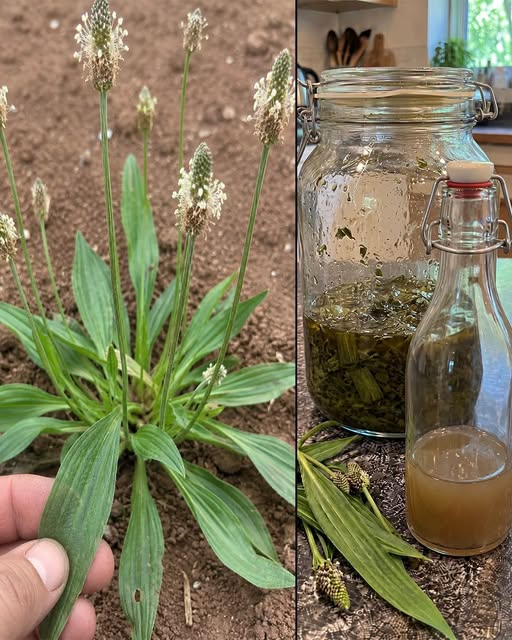
The plant shown in the image appears to be a type of plantain, possibly broadleaf plantain (Plantago major) or a related species. It is recognizable by its leaves, which grow close to the ground, and its upright flower spikes.
For generations, plantain leaves have been used in traditional remedies for minor skin problems, wounds, and other complaints. Today, researchers continue to investigate the plant's chemical compounds and potential biological activities.
But how much do we actually know about its benefits? And what should you consider before using it as a homemade herbal preparation?
1. What Is Broadleaf Plantain?
Broadleaf plantain is a perennial herb found in many parts of the world. It often grows in lawns, gardens, fields, and along paths.
Its scientific name is Plantago major. Despite sharing the word “plantain” with the familiar cooking banana, it belongs to a completely different plant family.
The plant has several recognizable characteristics:
Broad green leaves that grow in a low rosette.
Prominent veins running lengthwise through the leaves.
Long, slender flower stalks.
Small flowers arranged in narrow spikes.
The ability to grow in a variety of disturbed soils.
Some related species, including ribwort plantain (Plantago lanceolata), have narrower leaves. Because these plants can resemble one another, a photograph alone may not be enough to confirm the exact species. <Cite refs={["turn472665search0","turn472665search2","turn472665search7"]}/>
2. Why Has Plantain Been Used in Traditional Medicine?
Plantain leaves have a long history of use in traditional herbal practices. Different cultures have used preparations made from the leaves for minor skin complaints, irritated areas, and other everyday ailments.
Traditional use is an important part of the history of medicinal plants, but it is not the same as proof that a remedy works.
Scientists have investigated plantain because it contains compounds such as polysaccharides, flavonoids, and other plant chemicals that may have biological activity.
Research has explored possible anti-inflammatory, antioxidant, and wound-healing properties. However, the strength of the evidence varies depending on the specific preparation, condition, and type of study.
A result observed in a laboratory does not necessarily mean that a homemade infusion or extract will produce the same effect in people. <Cite refs={["turn472665search12","turn472665search13"]}/>
3. Plantain Leaves and Skin Health
One of the best-known traditional uses of broadleaf plantain involves minor skin problems.
Researchers have investigated whether certain compounds in the plant may influence inflammation and processes involved in wound healing.
Nevertheless, there is not enough high-quality human evidence to recommend homemade plantain extracts as a proven treatment for wounds or skin diseases.
If you have a minor cut or scrape, safer basic care includes cleaning the area with clean running water and covering it with an appropriate sterile dressing.
Avoid placing unwashed wild leaves or homemade extracts directly onto broken skin. Soil, bacteria, pesticide residues, or other contaminants may introduce additional risks.
Seek medical attention for deep wounds, spreading redness, increasing pain, pus, or other signs of infection.
4. Could Plantain Have Anti-Inflammatory Properties?
Some laboratory and animal studies have investigated the possible anti-inflammatory activity of compounds found in Plantago major.
These findings have attracted scientific interest because inflammation plays a role in many health conditions.
However, evidence from laboratory experiments is not sufficient to establish that drinking plantain tea or applying an extract will reliably reduce inflammation in humans.
More well-designed clinical research is needed to determine which preparations might be useful, what doses would be appropriate, and whether the benefits outweigh potential risks.
Plantain should therefore not be promoted as a proven treatment for arthritis, chronic inflammatory diseases, or other serious medical conditions.
5. Does Plantain Support Digestive Health?
Plantain seeds and other parts of the plant have been used in traditional approaches to digestive complaints.
However, different species and plant parts have different compositions. Broadleaf plantain leaves should not automatically be treated as equivalent to other plant-derived products used for constipation or digestive health.
If you experience persistent constipation, abdominal pain, diarrhea, or other digestive symptoms, the appropriate treatment depends on the cause.
Do not rely on an unidentified wild plant to manage ongoing symptoms, and seek medical advice if problems persist or become severe.
6. How Is Plantain Prepared in Traditional Herbal Practices?
Traditional preparations have included infusions, decoctions, and preparations intended for external use.
The appearance of the jar and liquid in the image does not establish the plant's exact identity, the preparation method, its concentration, or whether it is safe to consume.
For this reason, this article does not recommend a homemade drink recipe or dosage.
Before considering any herbal preparation, it is important to confirm the species and determine whether the specific plant part and preparation are suitable for the intended use. Products intended for one purpose should not automatically be used for another.
7. Is Broadleaf Plantain Safe?
Plantain is discussed in herbal literature, but safety depends on the species, preparation, amount used, and individual circumstances.
Possible concerns include allergic reactions, contamination from the growing environment, and uncertainty about the strength of homemade extracts.
Keep these precautions in mind:
Do not consume a wild plant unless its identity has been reliably confirmed.
Avoid collecting plants from roadsides or areas that may have been treated with pesticides.
Do not apply unwashed leaves to open wounds.
Ask a healthcare professional before using concentrated herbal preparations, particularly if you take regular medication.
Seek medical advice before medicinal use during pregnancy or breastfeeding.
Never replace prescribed treatment for diabetes, high blood pressure, infection, or another medical condition with a homemade plant remedy.
Even plants with a long history of traditional use can cause adverse effects in some people. <Cite refs={["turn472665search13","turn472665search14"]}/>
8. How to Identify a Plant Before Using It
If you find a plant that resembles the one in the photograph, take time to identify it before considering any use.
Look at several features rather than relying on a single leaf:
Leaf shape: Broadleaf plantain generally has oval leaves, while related species may have long, narrow leaves.
Veins: Broadleaf plantain usually has several prominent veins running from the base toward the tip.
Flower spikes: Its small flowers grow along upright, narrow stalks.
Growing location: The plant often grows in lawns, gardens, and disturbed ground, but location alone cannot confirm its identity.
For a reliable identification, consult a local botanist, agricultural extension service, or qualified plant-identification specialist. Do not use an uncertain identification as the basis for consuming a wild plant.
Frequently Asked Questions
What is broadleaf plantain commonly used for?
It has a long history of traditional use, especially for minor skin complaints and wounds. However, traditional use does not establish that a particular preparation is clinically effective.
Can plantain leaves cure infections?
There is insufficient evidence to recommend homemade plantain preparations as a treatment for infections. Suspected infections may require medical assessment and specific treatment.
Is the plant in the image definitely Plantago major?
It resembles broadleaf plantain or a related species, but the photograph alone cannot confirm the exact identity. More detailed botanical examination may be needed.
Can I drink plantain leaf extract every day?
There is no established, evidence-based daily dose of homemade broadleaf plantain extract for general health. Its concentration and safety can vary, so regular medicinal use should be discussed with a qualified healthcare professional.
Is a natural remedy always safer than medicine?
No. Natural substances can still cause side effects, allergic reactions, contamination, or interactions with medication. Safety depends on the substance, preparation, dose, and individual health circumstances.
Final Thoughts
Broadleaf plantain is a familiar wild herb with a long history in traditional herbal medicine. Its distinctive leaves and upright flower spikes make it recognizable, and researchers continue to investigate the compounds it contains.
Although some early research is scientifically interesting, plantain should not be presented as a miracle cure or a replacement for proven medical treatment.
The safest approach is to identify the plant correctly, distinguish traditional use from established clinical evidence, and seek professional advice before using homemade herbal preparations.
Medical disclaimer: This article is for educational purposes only. It does not recommend consuming unidentified plants or using herbal preparations to diagnose, prevent, or treat disease.