The Hidden Meaning of the “M” on Your Palm: What Does It Really Reveal?
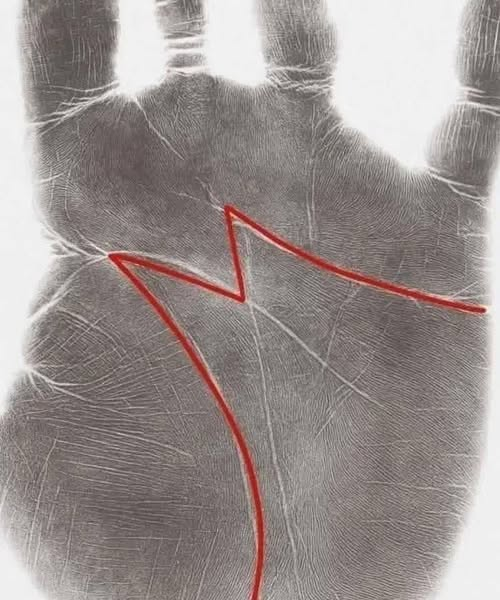
Have you ever looked at the lines on your palm and noticed what appears to be the letter “M”?
Palm-reading traditions have given this pattern all kinds of meanings, from personality and intuition to success, relationships, and even destiny. But there is an important distinction between traditional palmistry and what science actually tells us about the lines on our hands.
What Creates the “M” Shape?
The lines on your palm are known as palmar creases. Most people have three major creases, although their exact shapes, branches, and connections vary from person to person.
These creases develop before birth and are influenced by genetics and fetal development. Their primary physical purpose is related to how the skin folds and moves when we bend and grip with our hands. PubMed Central (PMC)
When several of these natural creases intersect in a particular way, they can appear to form an M-like shape.
What Does the “M” Mean in Palmistry?
In traditional palmistry, an apparent “M” is sometimes associated with:
Strong intuition
Determination and ambition
Leadership qualities
Independence
Good judgment
Success in business or career
Emotional awareness
Some palmistry traditions also claim that people with an “M” are especially good at recognizing when someone is being dishonest.
However, these are traditional interpretations, not scientifically established facts.
Can the Lines on Your Palm Predict Your Future?
There is no reliable scientific evidence that the shape of your palm lines can predict your future, wealth, romantic relationships, personality, or destiny.
Researchers do study palm creases for anatomical, genetic, anthropological, and medical purposes, but that is very different from using them to predict someone's life. PubMed Central (PMC)
So if you have an “M” on your palm, it can certainly be an interesting feature—but it doesn't scientifically mean that you're destined for success or a particular type of life.
Why Does Everyone Have Different Palm Lines?
Palm crease patterns can vary considerably. Some people have more branches, some have deeper or lighter creases, and occasionally two major creases join together to form distinctive patterns.
These variations are normal. In fact, researchers have identified several recognized patterns of palmar creases, including normal patterns and variants such as the single transverse palmar crease and Sydney crease. PubMed Central (PMC)
The Interesting Part
Even though palmistry cannot scientifically tell you what your future holds, your palm lines are still fascinating biological features.
They develop very early in life and remain relatively stable, which is one reason palm prints and dermatoglyphics are studied in science and medicine. PubMed Central (PMC)
So, Do You Have an “M” on Your Palm?
If you do, you're certainly not alone. The pattern simply comes from the way your natural palmar creases intersect.
Whether you see it as an interesting coincidence or enjoy the traditional palmistry interpretation, the “M” is a fascinating feature of the human hand.
This article discusses traditional palmistry beliefs for informational and entertainment purposes. Palm lines should not be used to diagnose medical conditions or predict someone's future.